
Expand transcript of audio narration
My future book project, Plundering the City, asks: How can a city’s social infrastructure be built up—or dismantled? Social infrastructure includes the everyday places that make it easy to meet people and build relationships outside the home. Corner stores and family businesses. Neighborhood associations and local newspapers. Public parks, libraries, and mass transit. Dense, walkable streets. These are all proven tools of urban design to promote social mobility.
I use the inner city of Newark, New Jersey, as a case study to examine the broader loss of social infrastructure in American urban life. The loss of local newspapers and family-owned grocery stores weakened the fabric of civic life and local democracy. Newark is an ideal site for this question. It is the poorest city in the world’s wealthiest region: the New York City metro area. Poverty is geographically close to economic opportunity but remains spatially separated and segregated due to urban design. My central claim is that this modern landscape of inequality is not accidental. It is the result of historically traceable investment, technology, and policy decisions.
To study this transformation, I built a large historical record from archives rarely used at this scale: 170,000 business records from city directories. 2,400 photo comparisons of past versus present street scenes. And decades of local newspaper reporting about neighborhood life. Rather than relying on mono-causal explanations like “race” or “white flight,” the findings tell a clear story of rise and erosion. In the early 1900s, the city’s compact, transit-oriented form empowered city dwellers and immigrants with access to economic opportunity. That intensity supported a thick web of small enterprises and civic institutions—the fabric of urbanism. However, over the twentieth century, technological change and market forces replaced old forms of social infrastructure with automobiles, highways, shopping malls, and TV entertainment.
The relevance to Detroit and peer cities is immediate. Plundering the City concludes that rebuilding requires more than construction or isolated design fixes. It requires rebuilding the ecosystem of institutions, using urban history as the guide for designing Detroit and peer cities. In order to be “good ancestors” and create an egalitarian metropolis, we must use urban history as our guide.
Expand 500-word summary of project
My future book project, The City of Tomorrow, asks how a city’s social infrastructure can be built up or dismantled. Social infrastructure includes the everyday places and neighborhood spaces that make it easy to meet people and build relationships outside the home. Social infrastructure describes the neighborhood institutions that organize daily life: corner stores and family businesses, neighborhood associations, local newspapers and libraries, public parks, mass transit, and dense, walkable streets that bring different groups into routine contact.
This project follows the inner city of Newark, New Jersey as a case study to examine the loss of social infrastructure in American urban life more broadly. The loss local newspapers, family-owned corner grocery stores, and thousands of other local institutions weakened the fabric of civic life and Newark’s ability to function as a democracy. Newark is a striking site for this question because it sits inside the extraordinarily wealthy New York City metro region—yet it is the poorest city in the world’s wealthiest metro region. Wealth and hardship are geographically close while remaining socially separated. The central claim is that this American city’s modern landscape of inequality is not accidental; it is the result of historically traceable investment, technology, and policy decisions that systematically weakened the social infrastructure of neighborhood life.
To study this transformation, I built a large historical record from archives that are rarely used at this scale: about 170,000 business records from city directories, roughly 2,500 photo comparisons of past versus present street scenes, about 250 building-level fire insurance maps, and decades of local newspaper reporting about neighborhood life. Rather than relying only on ten-year census snapshots—or on a mono-causal explanations like “race” and “white flight”—this research tracks neighborhood-scale institutions: what existed, where it clustered, and when it disappeared.
The findings tell a clear story of rise and erosion. In the early 1900s, the city’s compact, transit-oriented form concentrated people, jobs, shopping, and culture in and around downtown. That intensity supported a thick web of small enterprises and civic institutions—the fabric of urbanism—through which immigrant groups built community networks and, often, pathways into the middle class. Over the mid‑twentieth century, technological change and market dynamics replaced this older city with a landscape shaped by automobiles, highways, supermarkets, shopping malls, office parks, and suburban housing.
The relevance to Detroit, St. Louis, and peer cities is immediate. Communities wealthy and poor alike face parallel questions about mobility, neighborhood investment, and the institutions that support social connection and opportunity. This research concludes that rebuilding cannot be reduced to new buildings or isolated design fixes. It requires rebuilding the ecosystem of institutions and local power that sustains everyday community life—and asking what it would mean, now, to be “good ancestors. This work proposes the template of now-vanished urban forms and demolished neighborhood spaces as the template for rebuilding mass transit, small businesses, and the social fauna of community-owned institutions. Beyond simple narratives of white nostalgia (on the one hand) and the black community’s rejection of ethnic history as inherently “racist” (on the other), a more nuanced interpretation of past neighborhood forms provides the template to create an egalitarian metropolis today.
Committee:
Ana Morcillo Pallarés,
Robert Fishman,
Matthew Lassiter,
Dan O’Flaherty,
Kenneth Jackson,
Associate Professor of Architecture, Co-Chair
Professor Emeritus of Architecture, Co-Chair
Professor of History
Professor of Economics at Columbia University
Professor Emeritus of History at Columbia University
The City of Tomorrow
The Fate of Social Infrastructure in an American Community
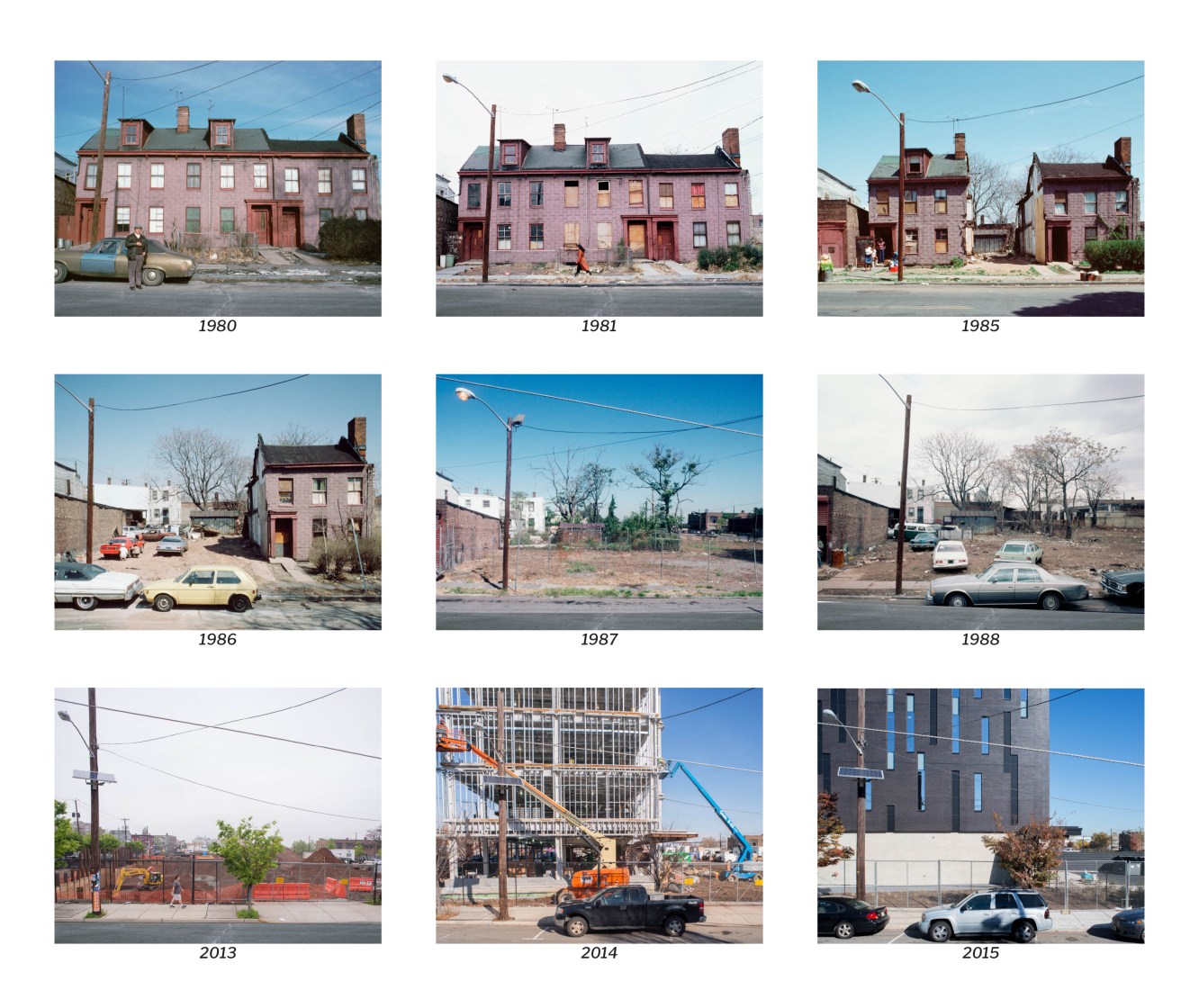
Time-lapse by Camilo José Vergara of 299 New Street
Abstract: This is the history of the poorest city in the world’s wealthiest metro region.
Social infrastructure empowers people to have chance encounters and social interactions outside the home. Corner stores and bodegas, family-owned businesses and local newspapers, all promote local culture and social lives outside the home. Walkable streets, public parks, population density, mass transit, local-scale craft industries, and shared neighborhood spaces encourage different social classes to mix. Some cities have social infrastructure – others do not. Social infrastructure can be created or destroyed – nurtured or abandoned.
This is the story of the poorest city in the world’s wealthiest metro region – and how this city of Newark became the way it is today. This mid-sized American city of 24 square miles is home to over 300,000 people. But this city is better known internationally for its port and international airport that serve New York City. And precisely because this city does not take center stage, its story presents an ideal microcosm to examine how technological progress and income apartheid segregate society between the working classes and the elite. The history of many places is mirrored through the story of one.1
This used to be a city where wealthy people lived, where working-class people built up a vibrant infrastructure of corner stores and community groups. It is a now a city that largely lacks abundant social infrastructure and meaningful pathways for working-class people to re-shape their built environment. In lonely pockets of urban poverty, a generation of people are living quiet lives of struggle and desperation. In neighborhoods without grocery stores and communities with limited access to public space, a generation of young people and families struggle to acquire the skills and tools needed to improve their situation.
A 20-minute subway ride away from this city, New York City is the world’s financial hub. New York is home to more billionaires than any other city in world history. The expansive New York metro region of 20 million people includes a dozen satellite cities, 27 counties, and 300-plus surrounding suburbs. One-fifth of all container ships carrying international goods pass through Port Newark. This region alone generates one tenth of the nation’s GDP. This metro region alone – if measured separately from the nation’s GDP – has a larger GDP than all of Russia’s. Despite its land area, and mineral wealth, the GDP for all of 1.3 billion people of sub-Saharan Africa is still lower than New York City. However, due to social policies and income inequalities, the nation’s wealthiest and poorest live parallel lives – never to cross paths. This study examines how social and technological change reshaped a city along spatial fault lines of social class and income apartheid.
From the 1910s to 1960s, technological change and market forces systematically eroded the city’s infrastructure of craft industries, corner grocery stores, and family-owned businesses. Market forces demolished an older city of mass transit, small businesses, and dense urban streets to create a newer city of highways, shopping malls, and endless suburbs.2 Population flight to the crabgrass frontier3 of suburbs deprived cities of the ability to sustain social infrastructure. The results are the death of a great American city4 and an urban culture of bowling alone.5
The poverty of families and loss of social infrastructure in the city today were not inevitable. Urban change was engineered. Thousands of other American cities – large and small – struggle on with the consequences of capital flight and technological change. Through novel research methods and spatial analysis of millions of census and phone book records, this study illustrates the evolution of community life in neighborhoods that are now cultural and food deserts. This evolution shapes the origins of today’s urban crisis – a crisis where few places in America have access to high-quality mass transit and social infrastructure. And many of those places that do have social infrastructure are unaffordable to most people.
As arson raged across the city and as capital fled to the suburbs in the 1970s, the city’s first black mayor, Kenneth Gibson, welcomed outside investment – in hopes that technological progress and corporate investors would reshape and revive the troubled city. His words of hope promised that the best was yet to come:
We’re going to make this a model city. […] If you talk about the urban problem in America, it’s here. If we solve the urban problem here, we can export our solution to other areas. [….] Wherever American cities are going, Newark is going to get there first.6
A half-century later of false starts and broken promises, these words ring hollow. The city might be able to regrow and build back new towers and apartment buildings. But mass consumption and the modern means of mass production have reshaped the city in irreversible ways. To truly reshape the city requires something more: systemic change and a new means of production to create community spaces with social infrastructure. A new social contract balances individual rights with the collective responsibility of environmental stewardship.
The current urban economy is unsustainable: “America does an excellent job generating wealth and a poor job translating that wealth into things we value.”7 The United States performs better than 98 percent of countries worldwide in economic output, but better than only 25 percent of countries in efforts at poverty reduction, 37 percent in voter participation rates, and 16 percent in terms of suicide prevention. The nation has systematically failed to leverage its unlimited material wealth to improve life, health, and urban outcomes for working-class people.8
To imagine the city – and its metro region – as it could be requires a serious and sustained engagement with urban history. Organizing for a truly egalitarian metropolis in the future requires us to learn from the templates of urbanism and social infrastructure that worked, and did not work, a century ago. This study visualizes the patterns of urbanism that worked, and did not work, a century ago – so as to equip communities today with a historically-informed vision for spatial justice and community organizing. To create social infrastructure today demands nothing less than seizing community control of the means of production.
Full text of project:
The full text is not published anywhere online. Please email me privately to request access.
Interactive mapping and web component of dissertation project:
Please visit NewarkChanging.org, a geo-located collection of 2,400 past vs. present photo comparisons of Newark’s vanished neighborhoods and community spaces in the 1950s vs. present day.
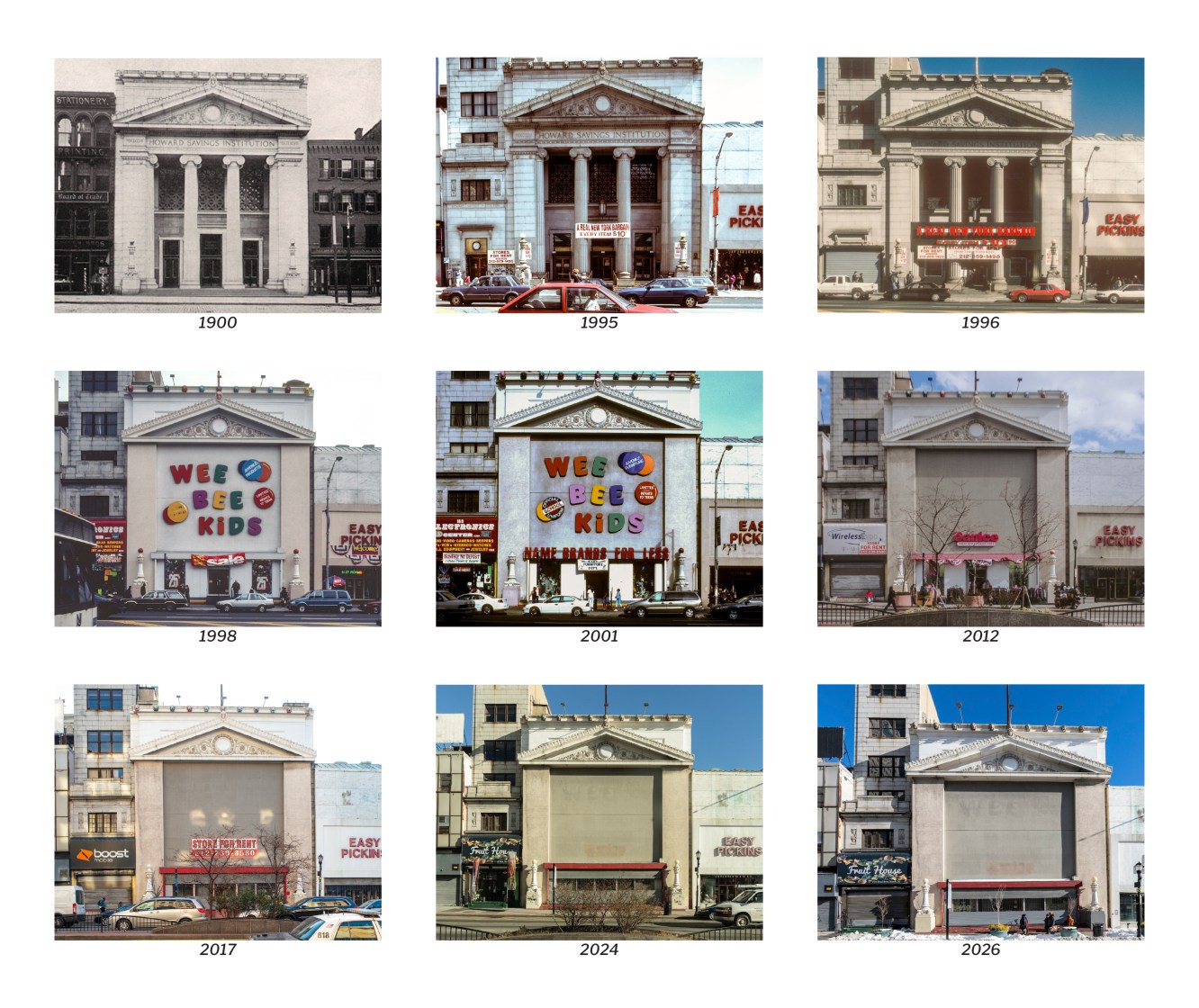
Time-lapse by Camilo José Vergara of Howard Savings Bank
notes
- Most Americans are familiar with racial apartheid. Few Americans are familiar with – or use – the term income apartheid to describe the economy we inhabit. However, American society is now more segregated by social class than by race. And forms of segregation based on income and social class are regularly tolerated. Between healthcare, schools, and social services, the black working class and the white working class alike suffer from income apartheid. ↩︎
- The methods of this study are largely inspired from the work of these four authors:
Douglas Rae, The City: Urbanism and Its End (New Haven: Yale University Press, 2003). ↩︎ - Kenneth Jackson, Crabgrass Frontier: The Suburbanization of the United States (Oxford University Press, 1985). ↩︎
- Jane Jacobs, The Death and Life of Great American Cities (New York: Random House, 1961). ↩︎
- Robert D. Putnam, Bowling Alone: The Collapse and Revival of American Community (New York: Simon & Schuster, 2000).
↩︎ - Joseph P. Fried, “Kenneth Gibson, 86, Dies; Newark Mayor Broke Race Barrier in Northeast,” The New York Times, March 31, 2019, nytimes.com/2019/03/31/obituaries/kenneth-a-gibson-dead-at-86.html. ↩︎
- Nicholas Kristof, “The States Where Life Is Better,” The New York Times, June 6, 2026, nytimes.com/2026/06/06/opinion/happiness-trust-americans-states.html. ↩︎
- “Summary of Results,” State of the Nation Report, 2025, StateofNation.org. ↩︎
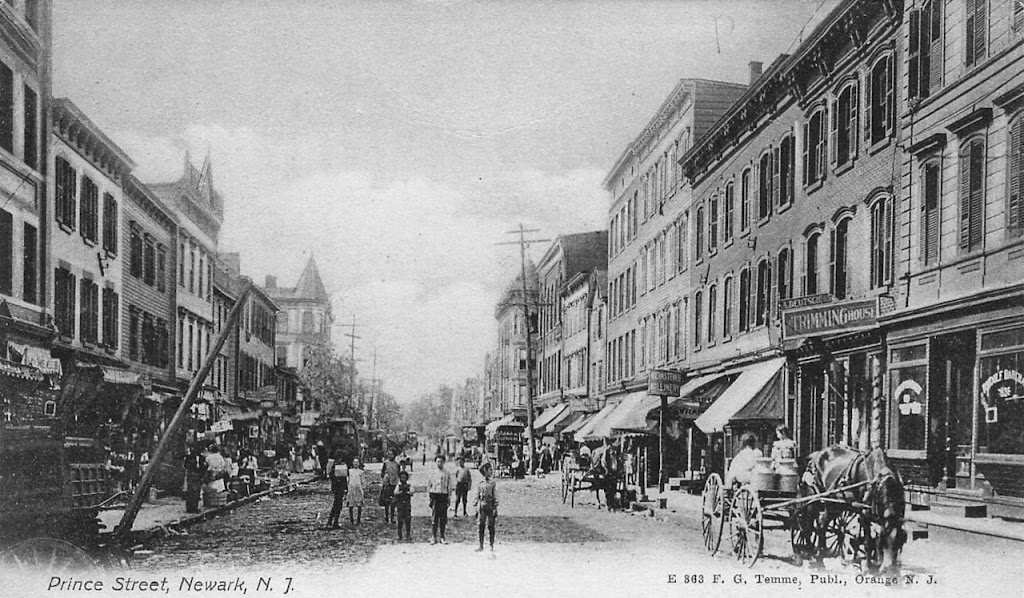
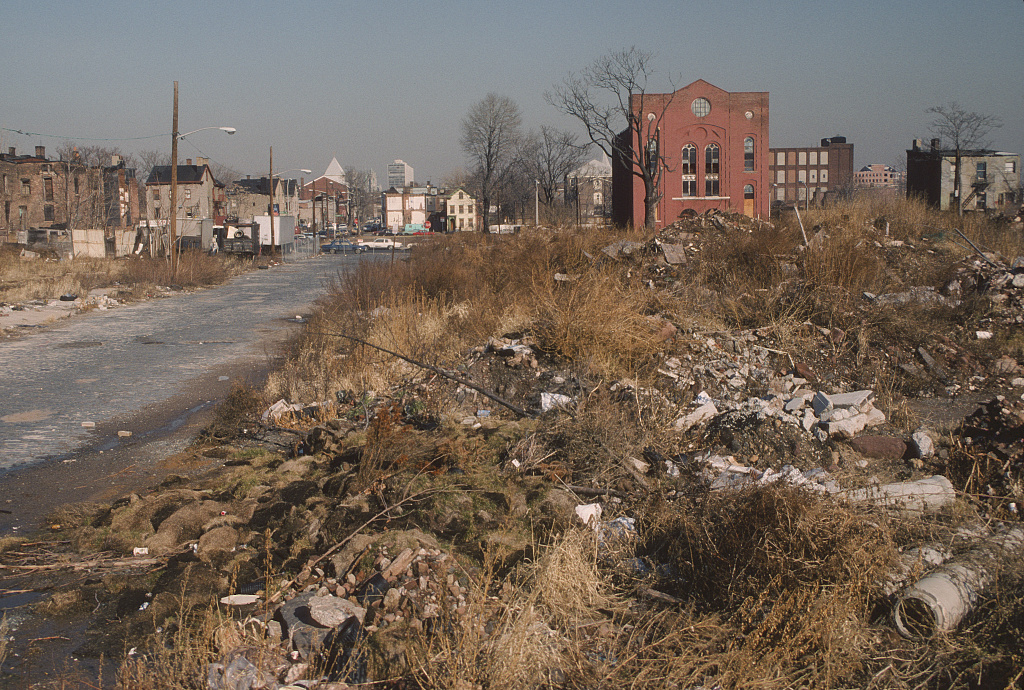
Prince Street in 1916 vs. 1990