
“They claim this mother of ours, the Earth, for their own use, and fence their neighbors away from her, and deface her with their buildings and their refuse. They compel her to produce out of season, and when sterile she is made to take medicine in order to produce again. All this is sacrilege.”
– Sitting Bull, leader of the Lakota Peoples, murdered 1890
1. Historical Film
Click below to play 12-minute video >
Expand full text of audio narration
This historical model reconstructs Chicago’s slaughterhouses in the year 1900.
Growing railroads penetrated the interior. The bison killed off. Tribal lands became farmland for corn, cattle, and pigs.
By 1900, the nation had more railroad miles than the rest of the world combined. Half a million acres were farmland and pasture for cattle. The nation’s web of railroads converged on Chicago. Chicago was midway between western farms and eastern cities.
In 1900, the United States was the world’s largest consumer of beef. Chicago’s Union Stock Yards supplied 80% of the nation’s beef.
Chapter 1. Preparing for Slaughter
“They don’t waste anything here. They use everything about the hog except the squeal.” – Upton Sinclair
Chicago had the world’s densest concentration of freight railroads. Cattle slaughter required nation-spanning logistics. Slaughterhouses worked with warehouses, sausage factories, glue factories, fertilizer factories, and others. No part of the animal was wasted. This was the world’s largest industrial complex in 1900. The scale of animal slaughter required innovations in killing, processing, refrigeration, and shipping.
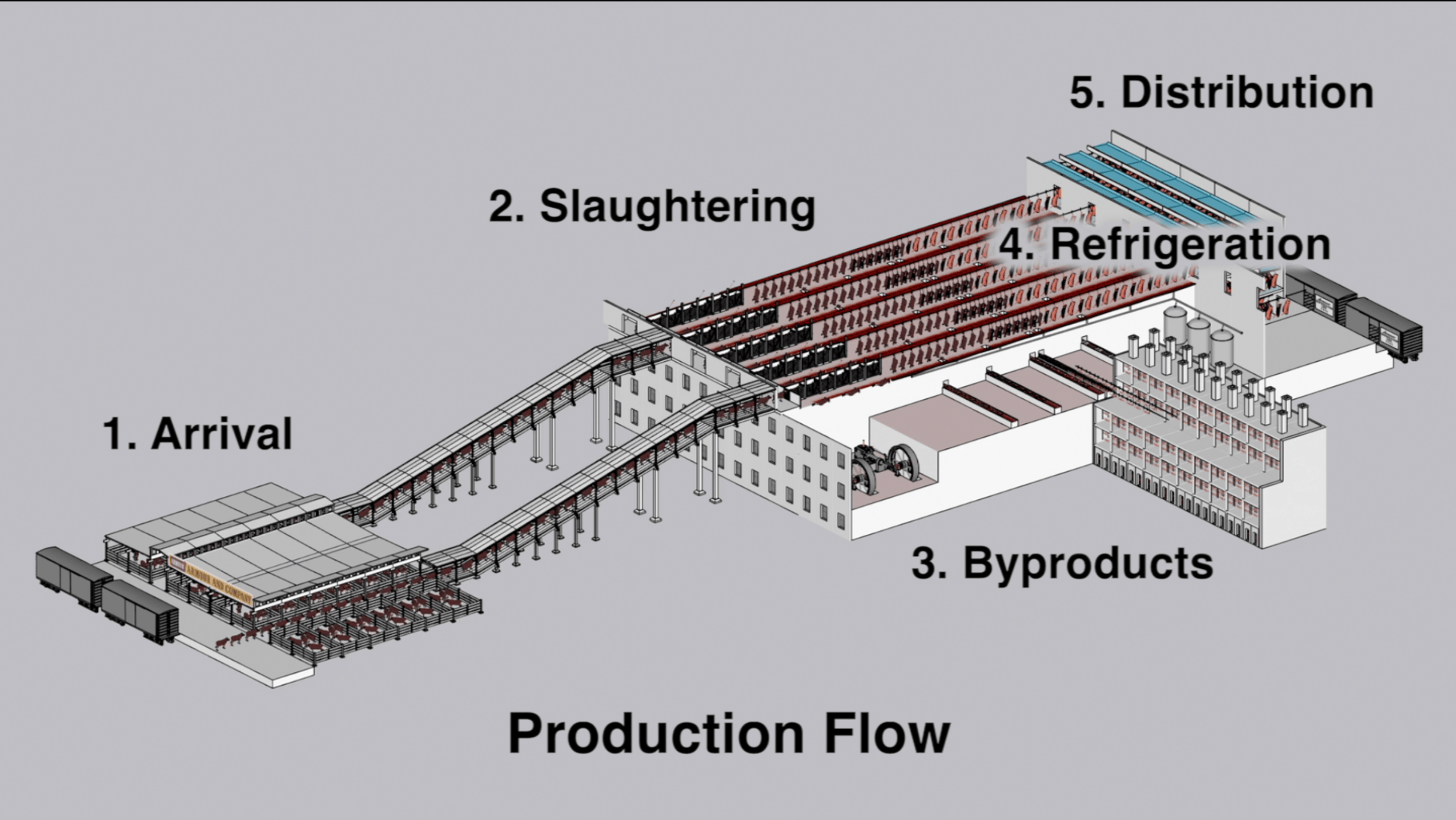
Shown here is a schematic drawing of the exact workflow. This was the world’s first moving assembly line.
The template of this factory in 1900 informed the design of most modern factories. About 30,000 people worked here. Most of them were immigrant men, women, and children. Half the complex was for animal slaughter and the other half for animal storage in stockyards. 30,000 cattle arrived each day by railroad. They were stored in 500 acres of stockyards. Animals waited up to a week before slaughter. Pigs and sheep lived in barns. Cattle lived in outdoor enclosures.
Hundreds of thousands of tourists visited the stockyards each year. This was among the city’s largest tourist attractions after the Chicago World’s Fair. Tourists marveled at the efficiency of animal slaughter. For the first time in human history, millions of working-class people could eat cheap meat.
We have reconstructed here less than 1% of the factory floor. Multiply the dimensions you see here by 100 to envision the scale of this factory.
Seven days a week, 10 miles of walkways guided animals from holding pens to killing floors. Some factories specialized in beef, others in pork, rarely chicken. The sound and smell of animals spread for miles around.
Before electricity, animals were made to transport themselves to their own deaths. Animals entered the top of the slaughterhouse, and then their corpses slid on chains back down to ground level.
Let’s follow the journey of one cow from stockyards to factory floor to freezer.
In 1900, most operations were gravity-powered. The moving assembly line eliminated the need for the butcher’s skilled labor. Work that once required 12 hours was now finished in just 30 minutes. Unskilled immigrant labor replaced the skilled labor of butchers.
Chapter 2. Slaughtering Methods
The most difficult job on the assembly line was in the killing pen. Killing pens were arranged sequentially. The first killing pen set the pace for all others down the line. In this way, management could speed up the rate of production to extract cheaper labor from overworked immigrants. Killing pens alternated with waiting pens. Men with hammers waited on a platform above the killing pen.
Animal slaughter required brute force. This system killed a cow in 60 seconds. The process repeated 8 to 10 hours a day. One worker could kill up to 400 cattle a day.
The force of gravity slowly rolled the carcass down the conveyor line. Disassembly lines were arranged in parallel to maximize efficiency.
Upton Sinclair described these methods of mass production in 1905:
“At the top of the wheel he was shunted off upon a trolley and went sailing down the room. The uproar was appalling, perilous to the eardrums. One feared there was too much sound for the room to hold, that the walls must give way or the ceiling crack. There were high squeals and low squeals, grunts and wails of agony.”
Chapter 3. Animal Byproducts
“The manner in which they did this was something to be seen and never forgotten. They worked with furious intensity. There came the headsman, whose task it was to sever the head with two or three swift strokes. Then came the floorsman to make the first cut in the skin, and then another to finish ripping the skin down the center, and then half a dozen more in swift succession to finish the skinning. It was all highly specialized labor, each man having his task to do. Another rolled it up and tumbled it through one of the inevitable holes in the floor.”
“The beef proceeded on its journey. There were men to cut it and men to split it and men to gut it and scrape it clean inside. There was a building to which the grease was piped and made into soap and lard. And then there was a factory for making lard cans. There was a great steam power plant and an electricity plant.”
“No tiniest particle of organic matter was wasted. Out of the horns of the cattle, they made combs, buttons, hairpins, and imitation ivory. Out of the shin bones and other big bones, they cut knife and toothbrush handles before they made the rest into glue. The party descended to the next floor, where the various waste materials were treated. Here came the entrails to be scraped and washed clean for sausage casings. Men and women worked here in the midst of a sickening stench, which caused the visitors to hasten by gasping.”
“Ham was made out of the waste ends of smoked beef that were too small to be sliced by the machines; also tripe dyed with chemicals so that it would not show white; trimmings of hams and corned beef; potato skins and all; and finally the hard, cartilaginous gullets of beef after the tongues had been cut out. All this ingenious mixture was ground up and flavored with spices to make it taste like something.
“To another room came all the scraps to be tanked, which meant boiling and pumping off the grease to make soap and lard. Below they took out the refuse, and this too was a region in which the visitors did not linger. In still other places, men were engaged in cutting up the carcasses that had been through the chilling rooms.”
Butter, blood, fat, lard, fertilizer, leather, acid, glue, soap, oil, perfume, pet food, buttons, and a thousand other products.
“All the drainage of the square mile of packinghouses empties into Bubbly Creek, so that it is really a great open sewer. One long arm of it is blind, and the filth stays there forever and a day. The grease and chemicals that are poured into it undergo all sorts of strange transformations.”
Chapter 4. Meat Storage and Distribution
“And then the visitors were taken to the other parts of the buildings to see what became of each particle of the waste material that had vanished through the floor,” “and to the pickling rooms and the salting rooms, the canning rooms and the packing room,”
“where choice meat was prepared for shipping, destined to be eaten in all the four corners of civilization.”
“There were some with hose which threw jets of boiling water upon it, and others who removed the feet and added the final touches. In the end, the finished beef was run into the chilling room to hang its appointed time.”
“There were the beef luggers who carried 200-pound quarters into the refrigerator cars, a fearful kind of work that began at 4:00 in the morning and that wore out the most powerful man in a few years. There were those who worked in the chilling rooms and whose special disease was rheumatism. The time limit that a man could work in the chilling rooms was said to be five years.”
“Cattle were being unloaded from the cars in the distance, and across the way, the beef luggers were toiling in the darkness.”
“It was the greatest aggregation of labor and capital ever gathered in one place. It employed 30,000 men. It supported directly 250,000 people in its neighborhood and indirectly, it supported half a million. It sent its products to every corner of the civilized world, and it furnished food for no less than 30 million people.”
“The line of the building stood clear-cut and black against the sky. Here and there, out of the mass rose the great chimneys, with the river of smoke streaming away to the end of the world. It was a study in colors, now this smoke. In the sunset light, it was black and brown and gray and purple. In the twilight, it was a vision of power.” – Upton Sinclair, 1905
2. Project Abstract
This virtual reality model – based on primary sources and historical descriptions – reconstructs the production methods and labor conditions of the Chicago Union Stockyards in 1906.
Follow through this model as we reconstruct how animals were prepared for slaughter, transformed into animal byproducts, refrigerated, and distributed across the nation’s rail network. The brutal efficiency of this system slaughtered 30 million cattle per year in 1900.
Before Henry Ford began production of the Model T in 1908, the world’s largest meat packers – Armour & Swift of Chicago – had already perfected, decades earlier, brutally efficient technologies to transform millions of cattle into cheap meat and low-quality animal byproducts.
3. Historical Research Method
This 12-minute animation is based on the historically rigorous interpretation of three key primary sources: 1) the 1890 Sanborn fire insurance maps of the slaughterhouses, 2) an 1890 aerial perspective of the factory complex, and 3) Upton Sinclair’s colorful descriptions of working conditions – based on the several weeks he spent working in and observing the slaughterhouse’s methods of mass production.
Based on tracing the exact build footprints of rooms and various stages in the production process from the historical map shown below, we reconstructed the slaughtering methods. Based on narrative descriptions and detailed elevations included in beef industry publications and trade manuals, we reconstructed the exact layout of the cattle slaughtering pens. The results are a rigorously researched and historically informed accurate-to-the-inch model of the entire production process. See primary sources cited below:

4. Works Cited
Textual and Primary Sources:
Expand list
Detailed descriptions of the production methods, as well as accurate-to-the-inch floor plans and structural elevations of actual slaughterhouse operations, are pulled from this book: H. Peter Henschien. Packing House and Cold Storage Construction. Chicago: Nickerson & Collins Company Publishers, 1915. Digitized in full and available for free download from the Internet Archive.
For analysis of meat production methods and operations, read: Frank Uekötter. “Chicago’s Slaughterhouses: Animals on the Line.” In Vortex, The: An Environmental History of the Modern World. University of Pittsburgh Press, 2023.
Also see this documentary about the history of Chicago’s Union Stockyards: Daniel Andries and Robert Loerzel. The Union Stockyards. 2022 documentary for PBS Chicago (WTTW), 55 minutes.
Visual and Narrative Sources:
Expand list
The perspective overview map is pulled from the “Rascher’s bird’s-eye view of the Chicago packing houses & union stockyards.” This map was created in 1890, to accompany and illustrate the series of building-level, detailed fire insurance maps of the stockyards and slaughterhouses. These historical maps informed our understanding of production methods and industrial geography. They are available to view or download from the digital collections of the University of Illinois Urbana-Champaign or from this 1894 map.
The opening sequence maps that show the nation’s spatial evolution are pulled from this series of time-lapse maps on railroading history, as well as this scientific article on changing American land uses over time.
Black and white photographs shown in this film were taken around 1906, as part of a publicity campaign by Armour & Co. These images are now in the digital collections of the Library of Congress.
The maze of livestock pens and walkways at Chicago’s stockyards, c.1947

Armour’s Food Source Map: The Greatness of the United States is Founded on Agriculture, 1932
Audio Sources
Expand list
Most of the audio narration is quoted from excerpts of Upton Sinclair’s 1906 book, The Jungle, available to read online in full. This book was instrumental in informing the general public about the working conditions of laborers and the foul, unsanitary conditions of meat production.
- Opening soundscape of an animal stockyard, based on live recording of an actual slaughterhouse
- Opening soundscape of a slaughterhouse, based on field recording
- “The Grid” from the 1982 film Koyaanisqatsi, composed by Philip Glass
- “No More Auction Block,” sung by Paul Robeson in 1937, based on lyrics from a 19th-century spiritual sung by former slaves on cotton plantations
- Soundscape inside a freezer?
- Sound of a freight train crash
- Sound of a freight train
- Boiling sound?
- Steam traction engine?